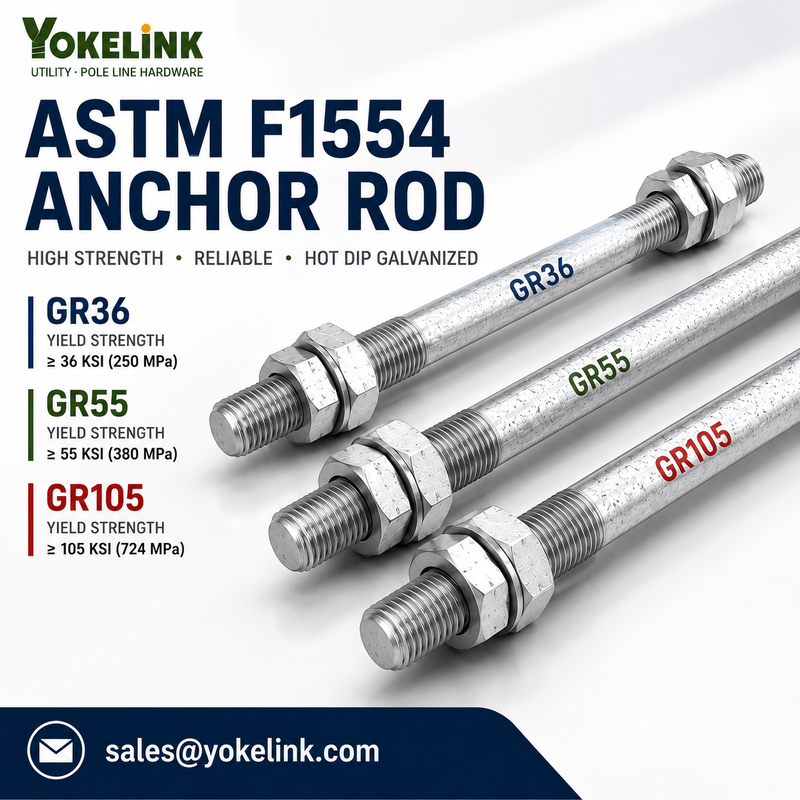
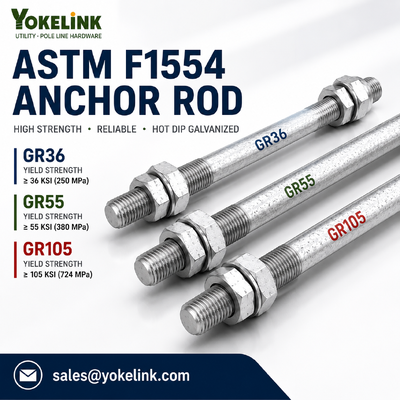
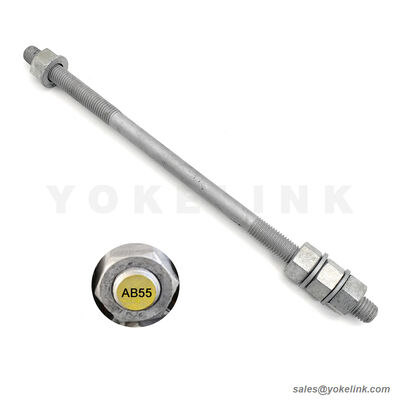
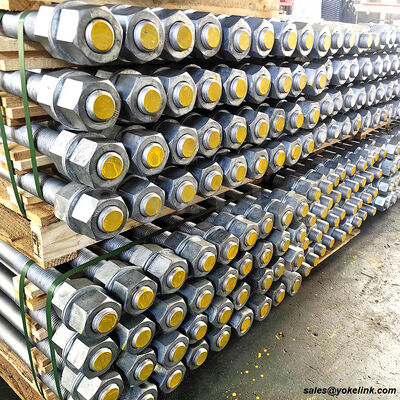
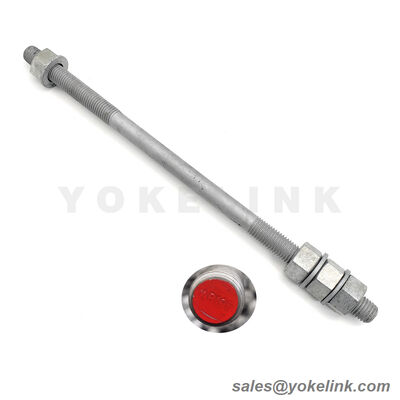
The ASTM F1554 Grade 55 Anchor Rods specification was introduced in 1994 and covers anchor bolts designed to anchor structural supports to concrete foundations. ASTM F1554 Grade 55 Anchor Rods can take the form of either headed bolts, straight rods, or bent anchor bolts. The three grades 36, 55, and 105 designate the minimum yield strength (ksi) of the anchor bolt. ASTM F1554 Grade 55 Anchor Rods can be either cut or roll threaded and a weldable grade 55 can be substituted for grade 36 at the supplier’s option. Color coding on the end – 36 blue, 55 yellow, and 105 red – helps facilitate easy identification in the field. Permanent manufacturer and grade marking is allowed under the S2 supplementary requirements.
Applications for ASTM F1554 Grade 55 Anchor Rods include columns in structural steel framed buildings, traffic signal and street lighting poles, and overhead highway sign structures to name just a few.
Key Features of ASTM F1554 Grade 55 Anchor Rods
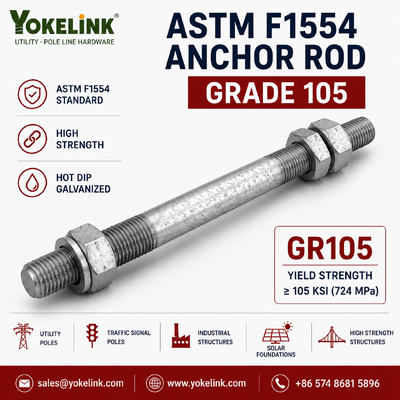
High Strength Performance: Manufactured to ASTM F1554 Grade 36, Grade 55, and Grade 105 requirements for reliable structural anchoring applications.
Multiple Configurations Available: Available in straight, J-type, L-type, and custom bent designs to meet various foundation and utility project requirements.
Hot Dip Galvanized Corrosion Protection: Available with hot dip galvanized finish for long-term corrosion resistance in outdoor and harsh environments.
Wide Range of Sizes: Offered in diameters from 5/8" to 2-1/2" and custom lengths according to project specifications.
Complete Fastening Solution : Supplied with matching ASTM A563 heavy hex nuts, ASTM F436 hardened washers, and anchor templates.
Suitable for Critical Infrastructure :Widely used in utility poles, transmission structures, traffic signal poles, lighting towers, solar foundations, and steel structures.
Custom Manufacturing Capability: Custom thread lengths, bends, projections, and assembly configurations available upon request.
Full Quality Inspection: Each batch undergoes dimensional inspection, thread gauge verification, mechanical testing, and coating thickness inspection.
Technical Specifications of ASTM F1554 Anchor Rods:
| Product Name |
ASTM F1554 Anchor Rods Grade 36/55/105 |
| Material |
Grade 36: Carbon Steel
Grade 55: SAE 1045 Steel
Grade 105: SAE 4140 Alloy Steel
|
| Accessories |
ASTM A563 DH Heavy Hex Nuts
ASTM F436 Washers
Plate Washers, Anchor Templates
|
| Type |
Full Threaded Rods
Double Ended Threaded
Single Threaded
J Type / L Type
Straight Type
|
| Size |
Grade 36 : 1/2~4''
Grade 55: 1/2~4''
Grade 105: 1/2~3''
|
| Finishing |
Hot Dip Galvanized |
| Grade |
Yield Strength |
Tensile Strength |
Typical Material |
| Grade 36 |
36 ksi (250 MPa) Min |
58-80 ksi |
ASTM A36 / Q235B |
| Grade 55 |
55 ksi (380 MPa) Min |
75-95 ksi |
SAE 1045 / ASTM A572 Gr.55 |
| Grade 105 |
105 ksi (724 MPa) Min |
125-150 ksi |
SAE 4140 / 42CrMo |
Manufacturing Process of ASTM F1554 Anchor Rods:
YOKELINK ASTM F1554 Grade 55 Anchor Rods are manufactured through a controlled production process to ensure compliance with ASTM F1554 requirements for dimensional accuracy, mechanical performance, and corrosion resistance.
Raw Material Inspection → Cutting → Forming & Bending → Thread Rolling → Heat Treatment (Grade 105) → Hot Dip Galvanizing → Quality Inspection → Packaging & Shipment.
1. Raw Material Inspection
High-quality carbon steel and alloy steel materials are selected according to the required grade. Chemical composition and material certificates are verified before production.
2. Cutting
Steel bars are cut to the specified lengths using precision cutting equipment to ensure dimensional consistency.
3. Forming & Bending
Anchor rods are formed into the required configurations, including straight rods, double-end threaded rods, J-type rods, and L-type rods, according to project specifications.
4. Thread Rolling
Threads are produced by thread rolling machines to achieve precise thread dimensions, improved surface finish, and enhanced mechanical strength.
5. Heat Treatment (For Grade 105)
Grade 105 anchor rods are quenched and tempered to achieve the required mechanical properties and high-strength performance.
6. Hot Dip Galvanizing
Anchor rods can be hot dip galvanized in accordance with ASTM F2329 or ASTM A153 standards to provide long-term corrosion protection in outdoor environments.
7. Quality Inspection
Each batch undergoes comprehensive inspection, including dimensional verification, thread gauge inspection, mechanical testing, coating thickness measurement, and visual examination.
8. Packaging & Shipment
Finished products are securely packed on pallets, in wooden crates, or according to customer requirements to ensure safe transportation and delivery.
Quality Control of ASTM F1554 Grade 55 Anchor Rods:
Every YOKELINK ASTM F1554 Anchor Rod is inspected to ensure compliance with ASTM requirements for dimensions, threads, mechanical properties, and coating quality.
What tests are performed on ASTM F1554 anchor rods?
YOKELINK performs material verification, dimensional inspection, thread gauge inspection, tensile testing, coating thickness measurement, and final visual inspection before shipment.
Are galvanized anchor rods inspected?
Yes. Hot dip galvanized anchor rods are inspected for coating thickness, surface finish, and compliance with ASTM F2329 or ASTM A153 requirements.
Applications of ASTM F1554 Anchor Rods :
ASTM F1554 Grade 55 Anchor Rods provide reliable anchoring solutions for traffic signal poles, sign structures, and roadway infrastructure. Grade 55 anchor rods are commonly specified by transportation departments across North America. ASTM F1554 Grade 55 and Grade 105 anchor rods are commonly used in solar energy projects for securing mounting structures to reinforced concrete foundations.
• Utility Pole Foundations
• Transmission Line Structures
• Traffic Signal Poles
• High Mast Lighting Poles
• Solar Mounting Systems
• Structural Steel Buildings
FAQ about ASTM F1554 Anchor Rods:
What are ASTM F1554 anchor rods used for?
ASTM F1554 anchor rods are used to secure utility poles, lighting poles, traffic signal structures, solar mounting systems, steel buildings, and heavy equipment foundations to concrete foundations.
Which ASTM F1554 grade is most commonly used?
Grade 55 is the most widely specified ASTM F1554 anchor rod for utility poles, lighting structures, traffic signal poles, and solar foundation applications.
Are ASTM F1554 anchor rods suitable for outdoor environments?
Yes. ASTM F1554 anchor rods are commonly supplied with hot dip galvanized coatings to provide long-term corrosion resistance in outdoor and harsh environmental conditions.
What is the difference between ASTM F1554 Grade 36, Grade 55, and Grade 105?
Grade 36 is a low-strength carbon steel anchor rod, Grade 55 offers higher strength and is the most commonly used grade, while Grade 105 is a high-strength alloy steel anchor rod designed for demanding structural applications.
What is the difference between ASTM F1554 Grade 36, Grade 55, and Grade 105?
Grade 36 is a low-strength carbon steel anchor rod, Grade 55 offers higher strength and is the most commonly used grade, while Grade 105 is a high-strength alloy steel anchor rod designed for demanding structural applications.
What nuts and washers are used with ASTM F1554 Anchor Rods?
Grade 55 anchor rods are typically supplied with ASTM A563 Grade DH heavy hex nuts and ASTM F436 hardened washers. Grade 105 may use ASTM A563 DH or ASTM A194 2H nuts depending on project requirements.
What is the yield strength of ASTM F1554 Grade 55?
ASTM F1554 Grade 55 anchor rods have a minimum yield strength of 55 ksi (380 MPa) and a tensile strength range of 75 ksi to 95 ksi (517–655 MPa). This combination of strength and ductility makes Grade 55 the most commonly specified anchor rod for utility, infrastructure, and structural applications.
Do ASTM F1554 Anchor Rods come with Mill Test Reports (MTR)?
Yes. YOKELINK can provide Mill Test Reports (MTRs) to verify material composition and mechanical properties. EN 10204 Type 3.1 inspection certificates are also available upon request to support project documentation and quality assurance requirements.